
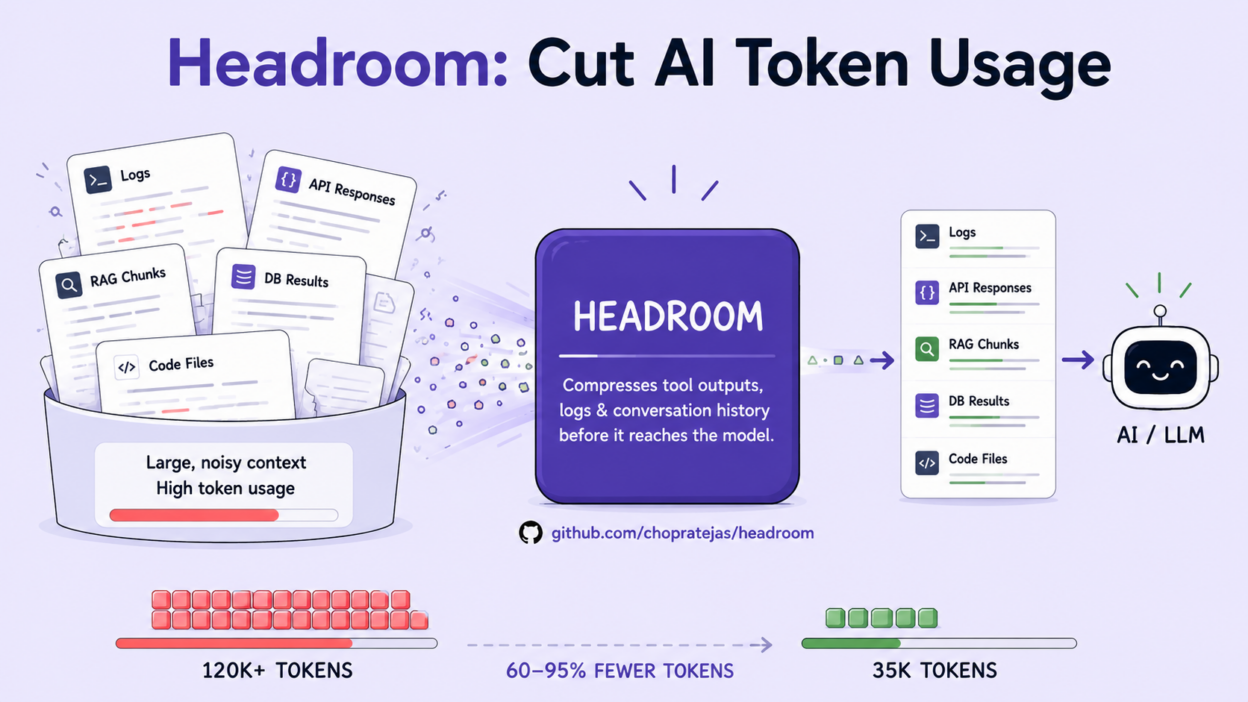
AI models continue to improve at an astonishing pace, but one constraint remains stubbornly persistent: token consumption.
Whether you’re building AI agents, running RAG pipelines, processing large log datasets, or working with tools such as Claude Code, Codex, Cursor, and Copilot, context windows can disappear surprisingly fast. Increased token usage not only affects cost but also limits how much relevant information models can effectively process.
How to Reduce AI Agent Token Usage Using Headroom
Headroom solves this in a refreshingly simple way. This is an interesting open-source project that approaches this challenge from a practical and scalable perspective.
For anyone interested, this is the GitHub repository of the compression tool: github.com/chopratejas/headroom
Instead of asking us to change the workflows, Headroom operates between the application and the LLMs, compressing tool outputs, logs, API responses, file reads, RAG chunks, and even conversation history before they reach the model. The result is a reported 60–95% reduction in token usage while maintaining response quality, a compelling advantage for agent-driven workloads.
What stands out is its broad ecosystem compatibility. Headroom integrates with custom AI applications, MCP environments, LangChain, LiteLLM, Claude Code, Codex, Cursor, and several other agent frameworks, making adoption relatively straightforward.
A few capabilities that caught my attention:
- Context isn’t discarded. Original data is cached locally and can be restored whenever the model requires full fidelity. The approach prioritizes context management rather than context loss.
- It fits wherever you already work. Use it as a Python/TypeScript library, drop it in as a zero-code proxy, an MCP server, or a lightweight wrapper around existing coding agents with minimal configuration.
- Headroom reduces not only inbound context but also outbound model responses by trimming repetitive code, redundant explanations, and unnecessary reasoning during routine operations.
- There’s a cross-agent memory layer too, so Claude, Codex, and Gemini help reduce duplicated work and improve continuity between agents.
As AI systems take on larger datasets, longer reasoning chains, and increasingly complex agent workflows, context efficiency may become just as important as model capability. Solutions that optimize token utilization could play a critical role in improving both performance and cost efficiency at scale.
Have you experimented with context compression, token optimization, or memory-layer solutions in your AI stack? I’d be interested in hearing what’s delivering meaningful results.