
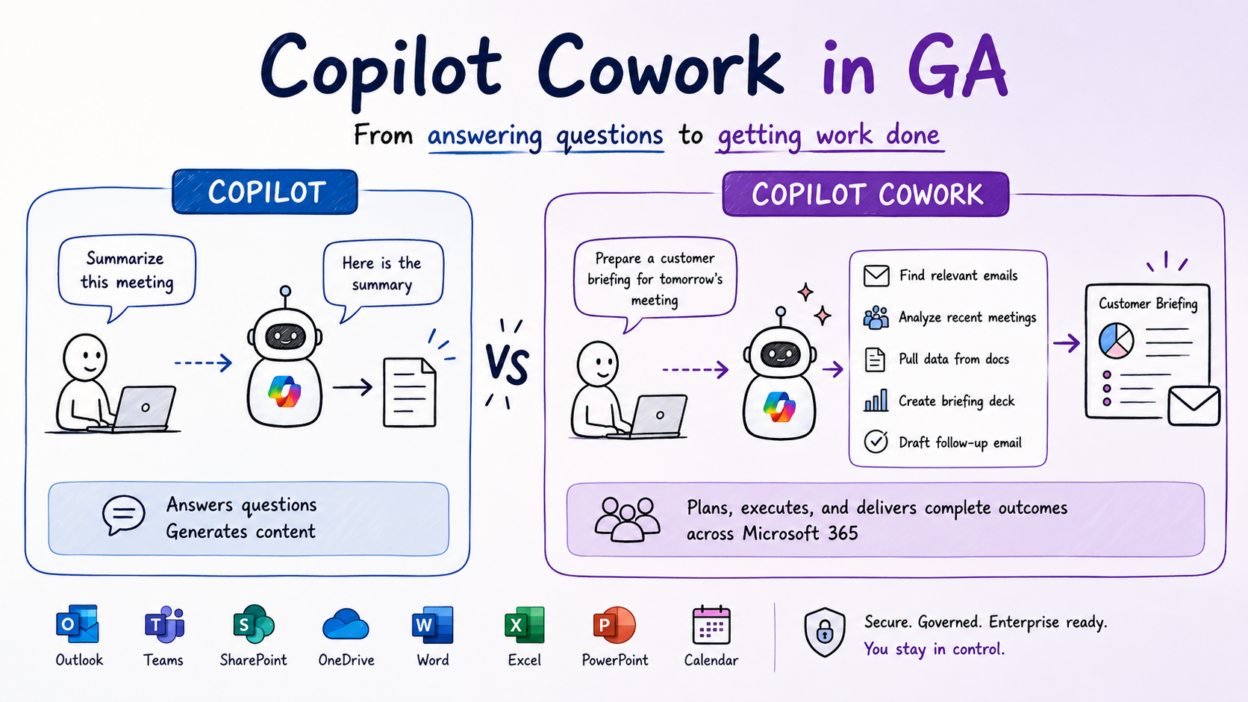
Copilot Cowork is generally available for Microsoft 365 Copilot customers worldwide. The interesting part isn’t the announcement, it’s the billing and execution model underneath it.
Quick context for anyone who’s only seen the chat experience: Cowork isn’t a Copilot Chat feature with extra steps. It’s a separate agentic runtime. You give it a task, it plans, calls tools, retrieves context from Work IQ, runs across multiple turns without you babysitting it, and hands back a finished artifact. Closer to handing work to a junior analyst than prompting a chatbot.
A few things M365 admins and architects should actually internalize before rolling this out:
- Cost isn’t per-seat anymore — it’s per-execution, and the meter has four inputs. Cost is driven by factors such as model selection, context retrieval, tool usage, and execution complexity, all of which influence Copilot Credit consumption. That means the same “task” phrased two different ways can cost very differently depending on how much it forces the agent to search, call connectors, or iterate. If you’re scoping this for a team, you’re not estimating “how many users” — you’re estimating prompt shape (light/medium / heavy) per persona, because a heavy task (broad aggregation, deep reasoning, many outputs) can burn credits at a completely different rate than a light one.
- Model choice is now a cost lever, not just a capability one. GA introduces support for Anthropic Opus 4.8 and Sonnet 4.6, with Microsoft also previewing its upcoming Cowork 1 model. The implication: once Cowork 1 lands, you’ll want routing logic (or at least guidance to your users) on when a task needs frontier reasoning versus when a cheaper fine-tuned model is enough. Unless you’re on Frontier, model selection options are currently more limited, reducing the ability to actively optimize cost versus capability.
- PayGo vs P3 is a real commitment decision, not boilerplate pricing copy. PayGo is $0.01/credit, no commitment. P3 introduces prepaid/committed consumption economics, making it more like a cloud capacity-planning decision than a traditional software license purchase.
- Browser use via Edge is currently Frontier-only, and it’s the part to watch. Cowork can drive a local Edge session under the existing enterprise policy. That’s a meaningfully larger attack/exposure surface than a tool-call-based agent — it’s effectively giving an agent a browser session with your policies applied. Worth testing in Frontier before it hits GA broadly, not after.
The “off by default” design is the right call, but plan the rollout like a phased feature flag, not a license assignment. Tenant admins have to explicitly turn it on, and you get group/user-level spend caps plus usage alerts before usage even starts.