
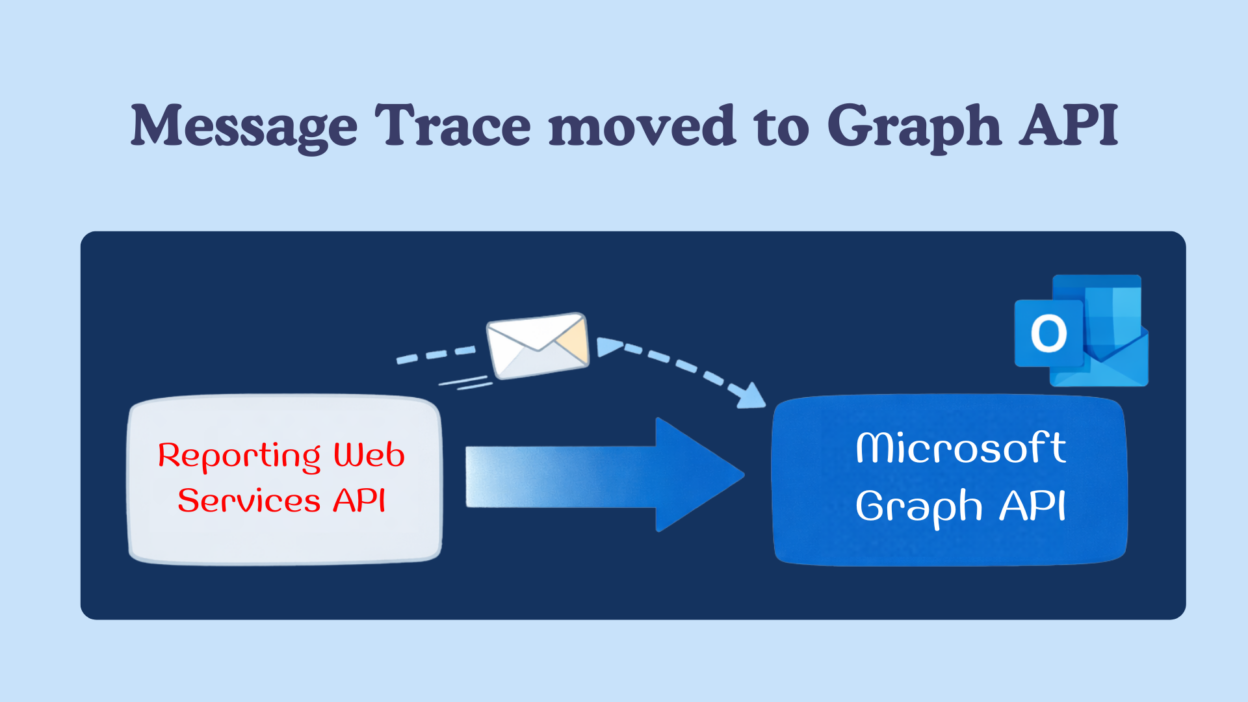
Microsoft has introduced native Message Trace and Message Trace Detail capabilities within the Microsoft Graph API, currently available in Public Preview, as part of its ongoing modernization of Exchange Online administrative and automation interfaces.
As part of this transition, Microsoft has announced the deprecation of the Reporting Web Service message trace endpoints, with retirement beginning on April 6, 2026. Organizations using legacy automation, monitoring solutions, or custom integrations must migrate to the Graph-based APIs prior to this date to maintain uninterrupted message tracing functionality.
The New Message Trace Experience in Microsoft Graph API
Microsoft has introduced Message Trace support in the Microsoft Graph API as the modern replacement for the legacy Reporting Web Service. This shift aligns Message Trace with Microsoft’s broader strategy of delivering secure, scalable, and centralized APIs across Microsoft 365.
The Reporting Web Service was built on an older SOAP-based architecture, which no longer fits the long-term direction of Microsoft’s platform modernization. By moving Message Trace into Graph, Microsoft now provides a unified programmability model where email tracing integrates seamlessly with other Microsoft 365 services.
With Message Trace available through Graph API, organizations benefit from:
- A modern RESTful experience
- Better consistency with other Microsoft 365 workloads
- Improved security and authentication standards
- Long-term extensibility and platform support
This transition simplifies development and administration by removing dependency on legacy protocols and fragmented authentication methods.
Microsoft Graph API Message Trace Capabilities
Microsoft Graph now includes full support for email tracing capabilities previously available in the Reporting Web Service.
The new API supports:
- Message Trace – query email flow across your Exchange Online organization
- Message Trace Detail – retrieve granular delivery and processing information
These endpoints provide the same functional coverage as the legacy service while offering better performance, scalability, and integration with Microsoft’s modern API ecosystem. Microsoft has defined a clear roadmap for the transition:
- Public Preview: Available now for worldwide tenants.
- General Availability: Rolling out at the end of January 2026, with full completion expected by early February.
- Deprecation Start: On April 6, 2026, the legacy Reporting Web Service message trace endpoints will begin deprecation.
New Exchange Online tenants are already provisioned without access to the Reporting Web Service. For these environments, Microsoft Graph API is the only supported programmatic method for message tracing.
While April 2026 may seem far away, migrating automated systems and scripts takes planning. The transition roadmap includes:
Message Trace Graph API Setup and Rate Limiting Guidelines
Due to Microsoft’s mitigation around service principal-less authentication, there is now an extra onboarding step.
To use the new Message Trace API, you must provision a specific Service Principal for Microsoft’s first-party app:
App ID: 8bd644d1-64a1-4d4b-ae52-2e0cbf64e373
This is done by creating an enterprise application from the multi-tenant app in Microsoft Entra ID.
After provisioning, it may take several hours for the service principal to fully activate. During this window, API calls might return 401 Unauthorized responses. This is expected and resolves once provisioning completes. Skipping this step can result in blocked requests!
Throttling Limits to Be Aware Of!
Performance stability is a primary goal of this update. To ensure that high-volume queries from one tenant don’t impact the service for others, Microsoft has implemented a rate-based throttling.
The limit is set at 100 requests per 5-minute window at the tenant level. This quota is shared between message trace queries and detail lookups. While “100 requests” might sound small at first glance, the capacity is actually quite significant:
- A single request can return up to 5,000 results.
- This allows you to pull up to 500,000 results every five minutes.
- In a 24-hour cycle, a well-optimized automation can retrieve up to 144 million results.
If your current scripts poll the API more frequently than 100 times every five minutes, you will need to refactor them to batch your requests or implement a retry-after logic to stay within these bounds.
How to Prepare for Migrating Message Trace to Microsoft Graph API
Your first step should be an audit of your existing environment. Identify any PowerShell scripts, third-party reporting tools, or custom SIEM integrations that currently use the Get-MessageTrace or Get-MessageTraceDetail cmdlets via the older Reporting Web Service.
- Start exploring the exchangeMessageTrace resource type in the Microsoft Graph Beta documentation.
- Provision the required Service Principal and run sample queries to ensure your data parsing logic remains intact.
- Ensure your automation logic accounts for the 100-request/5-minute limit.
The transition to Microsoft Graph is a significant step in making Exchange Online more manageable and secure. I suggest starting your migration during this Public Preview phase to ensure a smooth transition well ahead of the 2026 deadline.
My two cents….
Moving Message Trace into Microsoft Graph is a welcome and necessary modernization. It brings Exchange Online email tracing in line with Microsoft’s current API standards, improves long-term reliability, and simplifies integration with broader Microsoft 365 automation.
Adopting the Graph-based approach now not only avoids future disruption but also positions your environment for ongoing enhancements Microsoft will continue delivering through Graph.